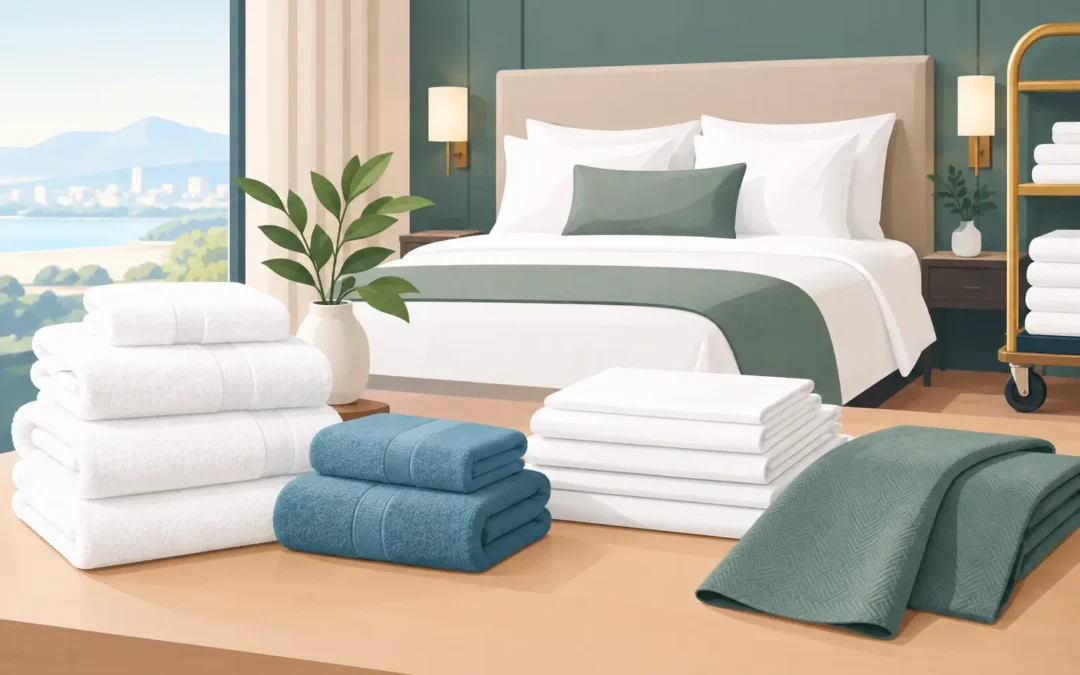
A towel that looks full and soft on delivery can become a cost problem after a few months of commercial washing. The same is true of sheets that pill, bath mats that wear thin, and pool towels that disappear faster than expected. This hospitality textiles guide helps operators choose linens for the conditions they will actually face: repeated laundering, daily turnover, guest expectations, storage limits, and operating budget.
The right textile program is not necessarily the heaviest or most expensive one. It is the one that gives your property dependable performance at a cost that makes sense per use. A motel with high room turnover has different needs than a boutique inn, spa, nursing home, fitness center, or seasonal pool facility.
What Hospitality Textiles Must Do
Hospitality textiles are working goods. They need to feel appropriate for the guest or client experience, but they also need to survive sorting, washing, drying, folding, transport, and frequent use. A purchasing decision based only on appearance can create avoidable replacement costs.
For most operations, the main selection factors are weight, fiber content, construction, size, color, and expected wash frequency. These details affect absorbency, drying time, durability, inventory levels, and labor. A heavier towel may offer a better hand feel, for example, but it can also take longer to dry and require more storage space. That trade-off may be worthwhile in a luxury guest room and unnecessary in a high-volume locker room.
First-quality merchandise matters because consistency matters. Institutional buyers need towels and bedding that match from shipment to shipment, fit their established par levels, and present a professional appearance. Mill seconds and irregular overruns may carry a lower price, but uneven sizing, weaving flaws, or color variation can complicate a program built around repeat ordering.
Start With the Actual Use Environment
Before comparing prices, define where the item will be used and what happens to it after use. A guest-room bath towel, salon towel, hospital washcloth, and pool towel are all towels, but they perform different jobs.
Guest rooms and lodging properties
Hotels, motels, vacation properties, and bed-and-breakfasts generally need towels and bedding that balance comfort with practical longevity. Bath towels should be absorbent without becoming too slow to dry. Hand towels and washcloths should be stocked in enough quantity to support turnover and sorting. White remains a common choice because it supports a clean presentation and simplifies replacement, though color can work well for decorative programs or designated uses.
For bedding, start with mattress size and depth. Fitted sheets must fit the actual mattress, including any mattress pad. Flat sheets, pillowcases, blankets, comforters, and pillows should be selected as a coordinated program rather than as isolated purchases. A comfortable bed presentation loses value when the sheets are too small, the pillowcases do not fit the pillows, or replacement items are difficult to match.
Spas, salons, and personal care
Spa and salon textiles need to combine appearance with stain management and frequent washing. Towels, washcloths, bathrobes, spa wraps, and aprons may come into contact with oils, cosmetics, hair color, and treatment products. White goods can be easier to bleach when appropriate, while darker colors can be useful where staining is a persistent visual concern.
Size is particularly important for wraps and robes. A product that is too small creates an uncomfortable client experience; one that is overly bulky can increase laundry volume. Buy for the intended treatment and client use, not just the lowest unit price.
Fitness, pool, and clubhouse operations
Pool towels and gym towels often face high loss rates, heavy soil, and rapid turnover. In these environments, a sensible institutional-grade towel may provide better value than a premium hotel towel. Consider whether the towel is complimentary, checked out, sold, or collected at a return point. That policy affects the amount of inventory you need more than towel weight alone.
Beach and pool towels also need visible color and practical sizing. Larger towels can improve the guest experience, but they occupy more space in carts, shelves, and dryers. If your operation has limited laundry capacity, that is a real operating constraint.
Health care, education, and residential care
Health care facilities, clinics, schools, and residential-care operations need dependable basics that support hygiene practices and repeated laundering. Durability, easy identification, consistent sizing, and available replacement stock are usually more important than decorative detail. Separate textile categories by use where needed, such as patient care, housekeeping, dining, or personal care, to support organized handling and inventory control.
Choose Towel Weight for the Right Reason
Towel weight is commonly measured in GSM, or grams per square meter. In general, a lower-GSM towel is lighter, dries faster, and is often suited to high-volume institutional use. A higher-GSM towel feels denser and more substantial, making it a better fit for upscale rooms, spas, and premium guest programs.
GSM should not be treated as the only quality measurement. Construction, cotton quality, loop formation, finishing, and laundering practices all affect how a towel performs. A very heavy towel can still disappoint if it is poorly made or washed under harsh conditions. Likewise, a properly selected institutional towel can provide excellent service life when it fits the application.
Use a lighter or midweight towel when fast drying, lower replacement cost, and high daily volume are the priority. Move toward a heavier towel when hand feel and a more premium presentation are central to the guest experience. Product lines such as Martex, Millennium, and Microcotton can serve different points along that spectrum, from dependable institutional use to a more luxurious bath experience.
Build a Bedding Program, Not a One-Time Order
Bedding purchases work best when they are planned around replacement cycles. A property should be able to reorder sheets, pillowcases, mattress pads, blankets, and comforters without redesigning the room setup every time inventory runs low.
Sheet selection depends on fiber blend, weave, size, and laundering conditions. Cotton-rich options can provide a familiar hand feel, while blended sheets may offer practical durability and easier care for commercial use. Neither is automatically better. The appropriate choice depends on your laundry process, target room rate, expected occupancy, and the feel you want guests to notice.
Do not overlook support items. Mattress pads help protect the mattress and add a layer of comfort. Pillows affect guest satisfaction immediately, yet they are often replaced only after visible wear. Blankets and comforters should match the climate, room temperature control, and housekeeping workflow. A large, difficult-to-launder comforter may not be the right choice for every property.
Plan for Laundering and Inventory Levels
A textile’s useful life is shaped by the laundry room as much as by the guest room. Excessive bleach, overloaded machines, high drying temperatures, and rough handling can shorten the life of towels and sheets. Follow care guidance, separate loads appropriately, and avoid treating every stain with the same aggressive process.
Inventory levels should account for use, laundry turnaround, emergency reserves, and loss. Buying only enough towels for occupied rooms or active users leaves no margin for delayed laundry, peak weekends, or damaged goods. On the other hand, overstocking bulky goods can tie up valuable storage space and cash.
For a straightforward purchasing review, confirm these five details before ordering:
- The intended application, from guest bath to housekeeping or pool use.
- The required size, including mattress depth and robe or wrap coverage.
- The weight and construction appropriate for expected laundering.
- The quantity needed for normal operation, backup stock, and replacement.
- The quality level that fits your budget and guest-service standard.
Buy on Cost Per Use, Not Price Per Piece
The least expensive textile is not always the lowest-cost choice. If a towel must be replaced quickly, sheds heavily, or creates guest complaints, its purchase price becomes less meaningful. A better measure is how many acceptable uses you receive before replacement, along with the labor and laundry resources required to keep the item in service.
This does not mean every operation should purchase luxury linens. A value-focused property can make a smart purchase with commercial-grade basics that are properly matched to its workload. A higher-end hotel or spa may reasonably spend more on plush towels, premium sheets, and bathrobes because the guest experience supports that investment.
United Textile Supply carries first-quality textiles across value, institutional, and luxury tiers, allowing buyers to source according to application rather than being forced into a single grade. The practical question is simple: what does this item need to do, and how long does it need to do it?
Make Reordering Easy
Once a textile program is working, document the item specifications, preferred colors, sizes, and normal order quantities. Keep a record of what lasted well and what created issues in laundry or guest feedback. This turns future ordering into a controlled purchasing process instead of a rushed response to empty shelves.
Start with a manageable test order when introducing a new towel weight, sheet construction, or premium product line. Put it through your actual wash cycle and ask the people who handle it every day for input. The best hospitality textile choice is the one that keeps working after the carton is opened, the rooms are turned, and the laundry is done.