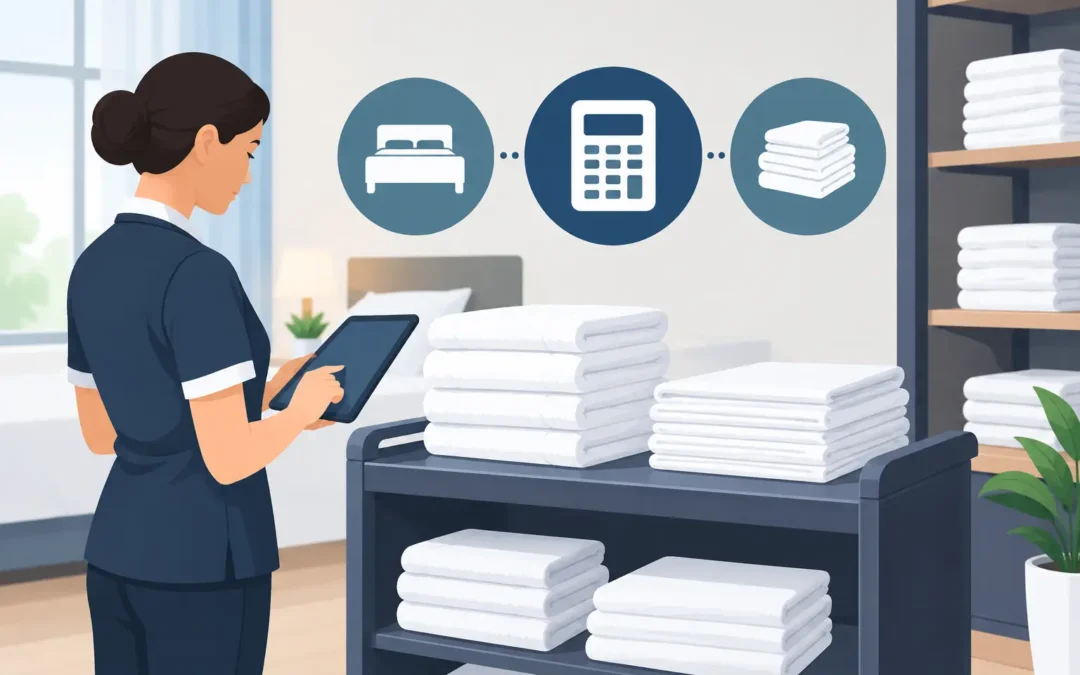
A hotel can appear fully stocked at check-in and still run short of bath towels, sheets, or pillowcases before the evening shift ends. The problem is usually not ordering too little in total. It is failing to calculate hotel linen par levels around the property’s real occupancy, laundry schedule, room mix, and replacement rate.
Par is the amount of usable linen a property needs on hand to operate without disrupting housekeeping or the guest experience. A sound par level gives staff enough clean goods for rooms, enough items moving through laundry, and enough reserve stock to cover delayed processing, heavy turnover, stains, damage, and unexpected occupancy.
What a Hotel Linen Par Level Means
A linen par is commonly described as the number of complete sets a property carries for each bed or room. A three-par system, for example, generally means one set is in the room, one is in laundry, and one is clean and ready for use. That is a useful starting point, but it is not a complete calculation.
A small property with reliable same-day laundry may operate comfortably at three par for some items. A busy hotel using an off-site laundry service may need four or more par because pickup, processing, delivery, and sorting add time. Pool towels, bath mats, and food-service linens also follow different use patterns than bed sheets.
The right number depends on how quickly linen returns to service and how much variation the operation can absorb. Par should be calculated by linen category, not as one total number for the entire hotel.
The Basic Formula to Calculate Hotel Linen Par
Start with this working formula:
Total linen required = daily units needed × par level + safety stock
For bed linen, daily units needed are based on the number of occupied beds or rooms, the number of pieces required per bed, and the expected change frequency. For bath linen, calculate each item separately because guests may use more than one towel and because towel loss and staining can differ significantly by item.
For a 100-room hotel with one king bed in every room, assume each occupied room requires one fitted sheet, one flat sheet, and four pillowcases. At 85 percent average occupancy, daily demand is 85 fitted sheets, 85 flat sheets, and 340 pillowcases if all occupied rooms turn over that day. If the hotel uses a three-par system, the base inventory would be 255 fitted sheets, 255 flat sheets, and 1,020 pillowcases before adding reserve stock.
That example is intentionally simple. Many hotels do not change every occupied room daily, while checkout rooms require complete resets. Your actual calculation should reflect your housekeeping policy and the percentage of rooms expected to depart each day.
Add Safety Stock Separately
Safety stock is the usable reserve that protects operations when linen is delayed, damaged, missing, or unexpectedly needed. For many properties, 10 to 20 percent above the calculated base is a reasonable planning range. A property with seasonal peaks, limited local laundry capacity, or a long delivery cycle may need more.
Using the example above, adding 15 percent safety stock brings the fitted-sheet requirement from 255 to about 294 pieces. Round up to a practical ordering quantity. It is better to hold a manageable reserve than to pull worn or mismatched linen into service because the clean shelves are empty.
Set the Par Level Around Your Laundry Turnaround
Laundry turnaround is the main reason one hotel can operate at three par while another needs four or five. Count the time from when a soiled item leaves a room until a clean, inspected item is folded, sorted, and available to housekeeping. Include transportation, receiving, sorting, washing, drying, finishing, and delivery to the linen room.
If linen is processed on-site and returned within 24 hours, three par may be sufficient for core bedding and towels. If an outside laundry picks up one day and returns the following day, a four-par level is often safer. If deliveries occur only a few times per week, calculate enough par to cover the longest gap, not the average turnaround.
Also consider the practical capacity of the laundry operation. A laundry may be able to wash the required pounds per day on paper but still fall behind after a convention checkout, a weather-related staffing shortage, or equipment downtime. That is where reserve inventory earns its place.
Calculate Each Linen Category on Its Own
A single property-wide par number hides the items most likely to create a shortage. Sheets, pillowcases, bath towels, hand towels, wash cloths, bath mats, pool towels, blankets, and table linens should be counted separately.
Bed linen should be calculated by bed type. A hotel with kings, queens, doubles, sofa beds, rollaways, and accessible rooms cannot use one sheet count across the board. Build counts around the exact sizes in service, then keep a small reserve for high-demand sizes. King fitted sheets are not an interchangeable substitute for queen fitted sheets, even when total sheet inventory looks healthy.
Bath linen requires a closer look at guest behavior. A select-service hotel may stock two bath towels, two hand towels, and two wash cloths per room. A higher-service property, spa, or resort may need more towels per guest, plus separate pool or fitness towels. Guests using a pool, hot tub, or fitness center can increase towel demand quickly, especially on weekends and during warm-weather periods.
For towels, use this formula:
Daily towel demand = occupied rooms × towels placed per room + expected extra-towel requests
Then multiply that demand by the chosen par level and add safety stock. Review extra-towel requests from housekeeping records if available. They provide better guidance than an assumption based only on room count.
Account for Loss, Damage, and Quality Standards
Par calculations only work when inventory counts reflect usable goods. A stained bath towel, torn sheet, thin wash cloth, or heavily pilled pillowcase may still be physically present, but it should not be counted as available guest linen.
Maintain separate counts for clean ready-to-use inventory, soiled inventory, items in process, condemned goods, and unaccounted-for loss. This makes it easier to see whether a recurring shortage is caused by too little par, delayed laundry, poor sorting, or replacement needs.
First-quality commercial linen helps create a more dependable baseline because sizing, construction, and finish are consistent from case to case. However, even durable goods wear out under frequent laundering. Set a regular replacement review instead of waiting for a shortage to force an emergency purchase.
A practical replacement allowance varies by product and property. Bath towels in a high-turnover hotel may be replaced more often than sheets, while pool towels can experience faster loss. Track what is removed from service each month. That record will show whether the safety stock is being consumed by normal wear or whether handling and security procedures need attention.
Use Occupancy Patterns, Not Just Annual Averages
Annual occupancy can be misleading. A hotel averaging 70 percent occupancy may still sell out several nights each week. Linen needs are driven by peak demand, checkout volume, group business, and laundry timing.
Review at least 60 to 90 days of occupancy and departure data. Identify the highest-demand periods, especially consecutive high-occupancy days. If Saturday is near sellout and Sunday brings a large checkout, the property needs enough clean linen to turn rooms while Saturday’s goods are still moving through the laundry cycle.
Seasonal properties should calculate a separate operating par for peak season. A mountain lodge, pool property, or event-driven hotel may not need peak inventory in every month, but it should have a documented plan for building stock before demand increases. Ordering after occupancy rises can leave the property exposed to supply lead times.
Put the Calculation Into a Simple Linen Worksheet
A useful worksheet does not need to be complicated. For each item, record the size or type, units placed per room, number of applicable rooms, expected occupancy, base par, safety-stock percentage, current usable inventory, and reorder quantity. Review it monthly and after any major change in room inventory, laundry provider, service standard, or occupancy pattern.
For example, if 80 queen rooms use four pillowcases each and the hotel operates at 90 percent occupancy, daily working demand is 288 pillowcases. At four par, the base requirement is 1,152. With 15 percent safety stock, the target is about 1,325 usable queen pillowcases. If the linen room has 1,080 usable pieces, the reorder need is about 245, before allowing for any planned replacement of worn goods.
Keep ordering units in mind. Cases and dozen packs can affect the final quantity, so round up to the next sensible pack size. Buying a few extra cases of a frequently used, standard item is often more practical than running a precise calculation that leaves no room for normal operating variation.
Choose Product Specifications That Support Your Par Plan
Par is not only a quantity decision. Product weight, size, fiber blend, weave, and intended use affect how long each item stays in service and how it performs in the laundry. A low-cost item that wears out early can create more frequent replacement work. A premium towel may improve the guest experience, but it may not be the right choice for every room class or high-loss environment.
Match the product to the application. Institutional-grade sheets and towels are built for repeat laundering and everyday turnover. Higher-end towel programs may fit suites, spas, or properties where hand feel is a larger part of the guest promise. Use consistent sizes and specifications whenever possible to simplify sorting, storage, replacement, and housekeeping setup.
A linen par should give your team confidence, not fill every storage shelf. Start with actual room demand, build in the turnaround time and reserve your operation requires, then review the counts often enough to correct problems before they reach the guest room.