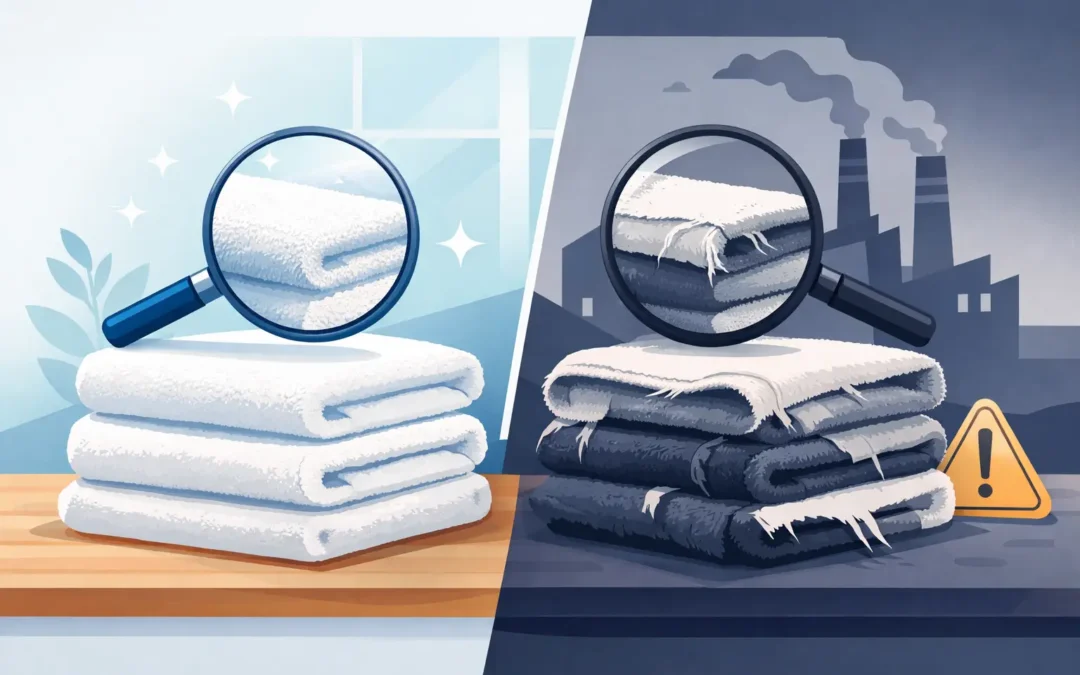
A towel that looks acceptable when it arrives can become an expensive problem after repeated commercial laundering. When comparing first quality towels versus mill seconds, the real question is not simply whether one costs less. It is whether the towels will deliver consistent size, absorbency, appearance, and service life across every room, treatment area, locker room, or household bath.
For hotels, spas, gyms, health care facilities, and other operations that depend on clean, presentable linens, first-quality merchandise provides a more dependable purchasing standard. Mill seconds may have a place in limited utility applications, but buyers should understand what they are giving up before making price the deciding factor.
What First-Quality Towels Mean
First-quality towels are made to the manufacturer’s intended specifications and have passed the quality review required for normal sale. That does not mean every towel is handmade or that no minor variation can ever occur. Textile production involves large runs, dye lots, cutting, weaving, and finishing processes. It means the product meets the stated standard for the towel line.
For a commercial buyer, that standard generally includes consistent dimensions, acceptable color, proper hemming, expected fabric weight, and a finish suitable for the listed use. If you order a case of institutional bath towels, you should be able to put them into service without sorting through obvious flaws or wondering whether some pieces will fail early.
First quality also gives buyers a more reliable basis for comparing products. A 16 x 27 inch hand towel, for example, can be evaluated by its construction, weight, cotton content, feel, and intended environment. The comparison is meaningful because the product is being sold as a regular, specification-compliant item rather than a downgraded lot with variable defects.
What Are Mill Seconds?
Mill seconds are towels that did not meet the mill’s requirements for first-quality sale. The reason can be minor or more noticeable. A towel may have an uneven hem, a weave irregularity, a small stain, a color variation, a pulled loop, an off-size cut, or an imperfect label. In other cases, the issue may affect how the towel performs or how long it lasts in service.
The challenge is that “seconds” is a broad category. One lot may contain towels with small cosmetic imperfections, while another may include substantial variation in size, color, or construction. Buyers cannot assume that every second is a bargain simply because the initial price is low.
For customer-facing applications, inconsistency creates operational friction. Housekeeping staff may need to sort towels before stocking rooms. A spa may find that a visibly irregular towel does not match the calm, polished experience clients expect. A property that uses color-coded linens may have trouble maintaining a uniform presentation if shades vary from piece to piece.
First Quality Towels Versus Mill Seconds for Commercial Use
The strongest case for first-quality towels is repeatability. Institutional textile buying is rarely about one towel. It is about dozens, hundreds, or thousands of towels performing consistently over time.
A hotel manager needs bath towels that feel and look similar from room to room. A salon needs hand towels that launder cleanly, stack neatly, and remain professional around clients. A nursing home or clinic needs linens that support a clean, orderly environment and can withstand frequent wash cycles. In these settings, a lower purchase price can be quickly offset by sorting time, early replacement, guest complaints, or a less polished appearance.
First-quality merchandise is also easier to reorder. When a buyer finds the right towel size, weight, and construction for an operation, the goal is to maintain that standard. Regular first-quality product lines are generally better suited to planned replenishment than clearance-style seconds lots, which can vary widely or disappear once sold.
That said, the right first-quality towel is not always the heaviest or most expensive option. A busy motel may need a value-focused institutional towel designed for frequent laundering and quick turnover. A boutique hotel or day spa may prioritize a fuller hand, higher cotton content, and a more luxurious appearance. A fitness center may need durable, easy-care towels in a practical size. The correct choice depends on the application, laundry process, guest expectations, and replacement budget.
Where Mill Seconds Can Make Sense
Mill seconds are not automatically unusable. They can be suitable when appearance is not important, consistency is not required, and the buyer has inspected or accepted the lot’s condition. Utility cleaning, equipment wipe-down, workshop use, moving, painting, or other back-of-house tasks may be reasonable uses for imperfect textiles.
Even then, buyers should consider labor. If employees must inspect, separate, trim loose threads, or discard a portion of a shipment, the apparent savings can narrow. A low-cost towel that cannot be assigned confidently to a specific use may create more handling than it is worth.
Seconds are usually a poor fit for guest rooms, treatment tables, pool decks, locker rooms, front-of-house restrooms, or any environment where customers see and handle the linen. They are also less attractive for organizations with established linen standards, color programs, or inventory controls.
Do Not Confuse Seconds With Overruns
An overrun and a mill second are not necessarily the same thing. An overrun may be extra first-quality production beyond the original order quantity. It can also refer to surplus inventory, discontinued colors, packaging changes, or closeout goods. Depending on the source, an overrun may be fully first quality.
The label alone does not tell the whole story. Ask whether the product is first quality, whether it meets listed dimensions and weight, and whether the inventory is consistent enough for your intended use. A closeout can offer excellent value when it is still first quality and the buyer does not need long-term color or style continuity.
How to Evaluate Towels Before You Buy
Price matters, but it should be considered alongside the towel’s expected working life and the role it plays in your operation. Before placing an order, confirm the product details that affect performance:
- Intended use: guest bath, salon, spa, fitness, pool, housekeeping, kitchen, or household use.
- Towel size: bath towel, hand towel, wash cloth, bath mat, or a specialty size.
- Weight and construction: lighter institutional towels may dry faster, while heavier towels typically provide a fuller feel.
- Fiber and finish: cotton content, loops, borders, and construction influence absorbency, feel, and durability.
- Laundry demands: frequent high-volume washing requires products selected for that workload.
- Reorder needs: if a program must remain consistent, select a product line that can support ongoing purchasing.
A practical purchasing decision also accounts for loss and replacement. Pool facilities, gyms, and student housing may experience higher towel loss than a small bed-and-breakfast. A lower-cost first-quality institutional towel may be the smarter operating choice in that situation than a premium towel or an inconsistent seconds lot.
The Cost Difference Is More Than the Invoice Price
A towel’s true cost includes its purchase price, laundry performance, handling time, usable life, and effect on the customer experience. If first-quality towels last longer, remain more uniform, and require less sorting, they may reduce the cost per use even when the upfront price is higher.
For residential buyers, the calculation is similar but simpler. A first-quality towel is a sensible choice when you want matching bath linens, dependable absorbency, and a product that retains a presentable look through regular washing. Mill seconds may be fine for garage cleanup or pet care, but they are rarely the best choice for a coordinated household towel set.
United Textile Supply focuses on first-quality textile merchandise because buyers need confidence in what they are putting into service. The goal is not to sell the most expensive towel for every job. It is to match the towel’s size, weight, durability, and quality level to the way it will actually be used.
When a towel represents your property, practice, facility, or home, consistency has value. Choose a first-quality option that fits the workload, then give it a fair test in your own laundry process before standardizing the next order.